VOL 1: THE THINKING MUSCLE
Why Critical Thinking is the First Resilience Skill
I. THE PROBLEM WITH FAST THINKING
When something goes wrong, really wrong, what matters most isn’t whether you have the right policy. It’s whether the people in the room can pause, think, and see the situation for what it really is.
Not what they hope it is.
Not what it used to be.
But what it is now, in all its ambiguity and tension.
Critical thinking is often described as a “soft” skill, or worse, a theoretical one. But in resilience leadership, it is foundational. Without it, we default to the most dangerous position in a crisis: overconfidence. We act based on assumptions, rely on habitual responses, or follow the crowd. And in doing so, we narrow our options at precisely the moment when we need to open them up.
II. WHY CRITICAL THINKING MATTERS IN RESILIENCE
Resilience is not just about recovering from impact but about recognising vulnerability early enough to act. That requires leaders who can slow the thinking, not just speed up the doing.
It’s the ability to ask:
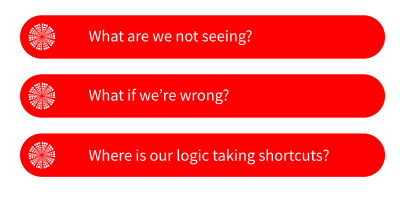
This is especially hard in high-performing environments. In these spaces, there’s often a strong bias towards certainty and clarity; qualities that feel safe and inspiring, but that can quickly become dangerous when they’re not real. In resilience leadership, clarity must be earned, not assumed.
III. WHERE THE THINKING BREAKS DOWN
One of the hardest things to do as a leader is to create the conditions where your own thinking can be challenged. Not just by others, but by yourself.
Cognitive biases, those predictable flaws in how we interpret information, are more active when we’re under pressure, moving quickly, or invested in a certain path. And these biases often go unchallenged unless we have disciplined critical thinking routines.
I’ve seen this in many boardrooms and executive teams.
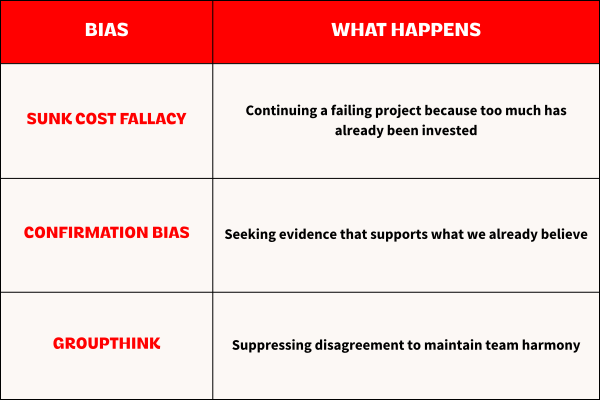
In each case, the thinking feels sharp, but is, in fact, stuck.
IV. BUILDING THE MUSCLE
So how do we build this capacity, not as an intellectual exercise, but as a leadership practice?
We start by noticing the moment when our thinking speeds up. That’s often the signal. When you feel pressure to make a fast decision, to agree with the dominant voice, or to simplify a complex issue just to create a sense of momentum.
That’s the cue to pause and test the quality of your thinking.
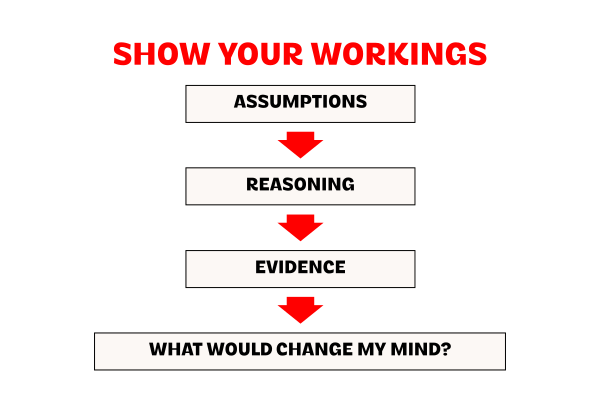
In my own work with leaders, we use a simple technique: show your workings.
Much like a maths teacher asking a student to explain how they arrived at an answer, we ask leaders to talk through their assumptions, their reasoning, and what might change their mind.
Not to slow them down, but to increase the surface area of insight and to invite challenge before the risk matures.
Critical thinking isn’t about being cautious. It’s about being clear-eyed. It’s the confidence to say:
“I’ve thought this through, I’ve questioned the data, I’ve explored alternatives, and this is the best course for now.”
V. RESILIENT LEADERS ASK DIFFERENT QUESTIONS
What sets resilient leaders apart is not that they always know the answer.
It’s that they know how to hold space for better questions, especially under pressure.
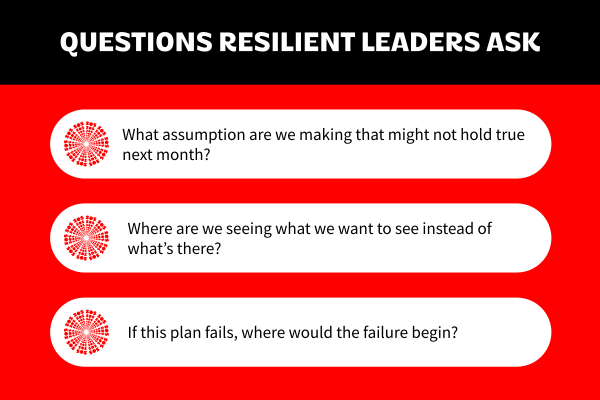
These questions aren’t just for reflection, they’re for rehearsal.
They should be used in real time, in meetings, during decision-making. Not because they make things easier, but because they make them more real.
VI. THE LINK TO THE LION
In the ResilienceSOS Mindset Pillars, the Lion teaches us to name what’s hard to say.
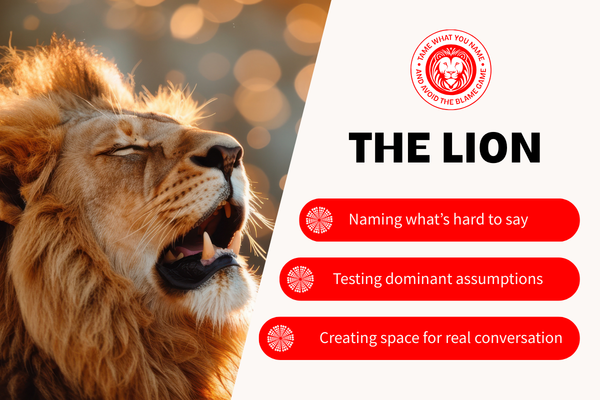
That’s critical thinking in action.
It’s not about having the best idea in the room, it’s about being willing to test the dominant one.
It’s saying:
“There’s something here we’re not accounting for.”
“That risk is named, but it’s not tamed.”
Naming doesn’t neutralise a risk. But it creates the space for shared analysis, which is the beginning of resilience.
VII. FINAL WORD: THE DISCIPLINE BEFORE THE DECISION
Resilient leadership begins with how we think, not just how we act.
In a world that rewards speed, visibility, and decisiveness, critical thinking is your competitive advantage. It allows you to make decisions that are not just fast, but informed.
That balance clarity with curiosity. That anticipate consequences, not just outcomes.
If resilience is the ability to navigate what’s next, then critical thinking is the compass.
Use it often. Sharpen it constantly. Trust it deeply.
🔁 NEXT IN SERIES: Professional Scepticism Isn’t Cynicism—Reclaiming Healthy Doubt in Leadership
Ready to put this into practice?
Start a conversation that builds resilience,
one scenario at a time.
Join the movement.
Follow ResilienceSOS® on LinkedIn for tools, insights, pathways and stories that help leaders lead through uncertainty.
© HumAIn Risk Pty Ltd, trading as ResilienceSOS®. All rights reserved. Please respect our intellectual property rights. This article and its contents are the intellectual property of ResilienceSOS®. You are welcome to use the insights and guidance contained in this article within your own organisation. However, unauthorised reproduction, distribution, or sharing of this article, in whole or in part, outside your organisation or for commercial resale is prohibited without our express permission.

