VOL 2: PROFESSIONAL SCEPTICISM ISN’T CYNICISM
Reclaiming Healthy Doubt as a Leadership Strength
I. WHAT HAPPENS WHEN NO ONE ASKS, “ARE WE SURE?”
In Volume 1 of this series, we explored why resilience can no longer be a side project — and how the ResilienceSOS® Mindset Pillars offer a mindset and language for turning disruption into growth.
This next part looks at what happens when that mindset moves from philosophy to practice — when resilience becomes something people do, not just discuss.
One of the first behaviours of resilient leadership is the ability to question what appears certain. That behaviour has a name: professional scepticism.
In many organisations, the riskiest moments aren’t those filled with drama or high-stakes chaos. They’re the quiet ones. The meetings where everyone nods along. The strategies that progress without question. The assumptions that pass unnoticed because they’re familiar, logical, or simply convenient.
This is where resilience falters—not through failure of effort, but through the absence of constructive doubt.
In those moments, professional scepticism isn’t just helpful. It’s essential.
And yet, in many leadership environments, it’s misunderstood—often dismissed as negativity, resistance, or a lack of alignment.
But here’s the truth: healthy doubt is one of the most underused assets in risk-aware leadership. And reclaiming it is one of the fastest ways to strengthen an organisation’s capacity to adapt, protect, and grow.
II. SCEPTICISM: WHAT IT IS (AND WHAT IT’S NOT)
Professional scepticism is not cynicism. It’s not distrust, or default negativity, or the exhausting habit of playing devil’s advocate in every conversation.
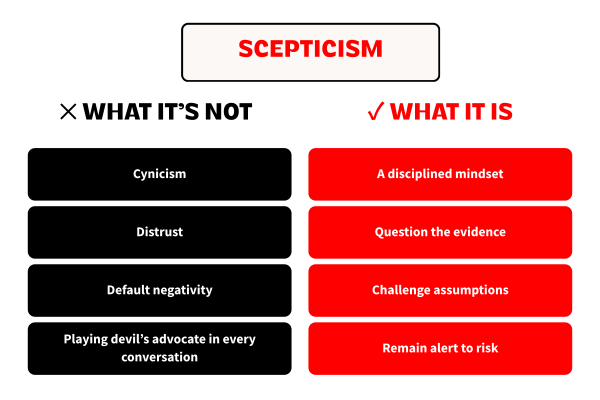
It is a disciplined mindset and a commitment to question the evidence, challenge assumptions, and remain alert to risk, even when things seem fine.
This mindset is embedded in professions like auditing, legal counsel, compliance and forensic investigation, where challenge is part of the process.
But in leadership, especially outside traditional risk roles, it’s often devalued.
Leaders are expected to be confident, visionary, aligned. And challenge, particularly in grey areas, can be read as defiance or delay.
This is a missed opportunity. Because it’s precisely in the grey that resilience gets tested.
III. THE COST OF SUSPENDED DOUBT
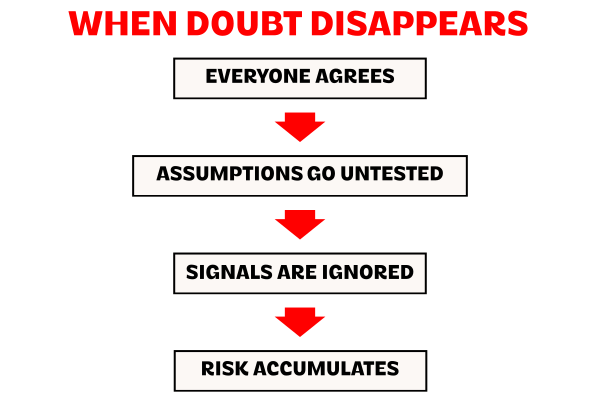
Most major organisational failures were not sudden.
They were accumulations of ignored signals, of risks that were seen but softened, or of decisions that should have been re-examined but weren’t.
Not because no one knew. But because no one was invited or safe enough to doubt.
Sometimes, it’s a well-meaning belief in the team:
“They’ve got this—don’t overcomplicate it.”
Other times, it’s pace:
“We’ll deal with it later—just get it done.”
And sometimes, it’s culture:
“We don’t challenge the leader. We trust the process.”
And then something breaks. A disruption hits. A reputation slips. A client leaves. And suddenly, scepticism looks like something we wish we had more of.
IV. SCEPTICISM AS A RESILIENCE SIGNAL
If critical thinking is how leaders examine what they’re doing, professional scepticism is how they examine why they’re so sure.
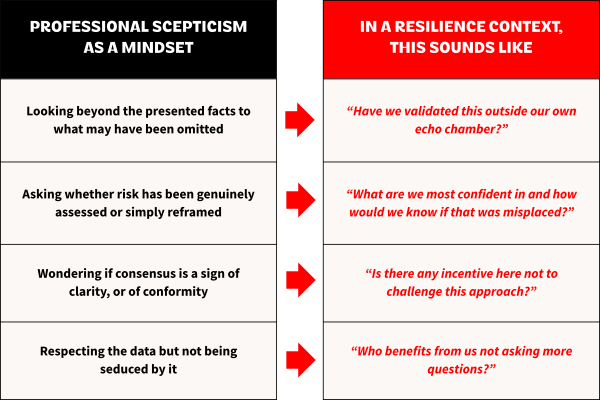
This isn’t disruptive. It’s protective. It strengthens decision-making by creating a layer of emotional and intellectual rigour.
V. BUILDING A CULTURE THAT INVITES HEALTHY DOUBT
Healthy scepticism isn’t just about the questions being asked.
It’s about how they’re received.
In high-resilience teams, leaders reward questioning even when it slows things down. They treat the sceptic not as the roadblock, but as the risk radar. They understand that challenge is a form of care, not disloyalty.
But to build that culture, leaders must go first.
That means:
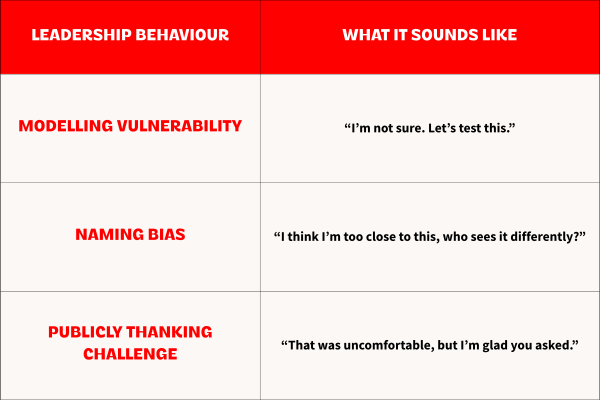
And when someone speaks up late in the decision process, instead of:
“Why didn’t you say something earlier?”
leaders ask:
“What gave you the courage to say something now?”
VI. A NOTE ON REGULATORY BACKING
This mindset isn’t just good practice, it’s increasingly expected.
In Australia, APRA’s CPS 230 (and similar global resilience regimes) place a clear emphasis on organisational awareness, disruption readiness, and board-level responsibility for resilience.
That cannot be achieved without sustained, structured scepticism from the boardroom to the frontline.
Scepticism helps surface known risks that have been normalised.
It prevents risk appetite from being “managed by mood.”
And it protects against the most dangerous sentence in any post-mortem:
“We kind of knew, but no one said anything.”
VII. FINAL WORD: REFRAME DOUBT AS A LEADERSHIP GIFT
Resilient leadership is not about projecting certainty.
It’s about stewarding the thinking that holds uncertainty safely and examines it honestly.
When leaders reclaim professional scepticism, not as resistance but as rigour, they strengthen not just the decision. They strengthen the system.
In a resilient culture, doubt isn’t dangerous, it’s developmental.
And the real risk is not that we ask too many questions, but that we don’t ask enough.
🔁 NEXT IN SERIES: Resilience and the Modern Leader—Connecting Radical Candor, Servant Leadership and Systems Thinking
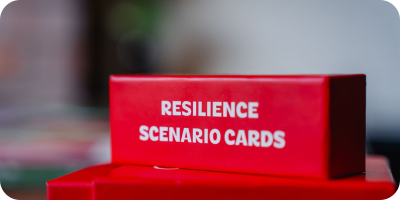
Ready to put this into practice?
Start a conversation that builds resilience,
one scenario at a time.
Join the movement.
Follow ResilienceSOS® on LinkedIn for tools, insights, pathways and stories that help leaders lead through uncertainty.
© HumAIn Risk Pty Ltd, trading as ResilienceSOS®. All rights reserved. Please respect our intellectual property rights. This article and its contents are the intellectual property of ResilienceSOS®. You are welcome to use the insights and guidance contained in this article within your own organisation. However, unauthorised reproduction, distribution, or sharing of this article, in whole or in part, outside your organisation or for commercial resale is prohibited without our express permission.

