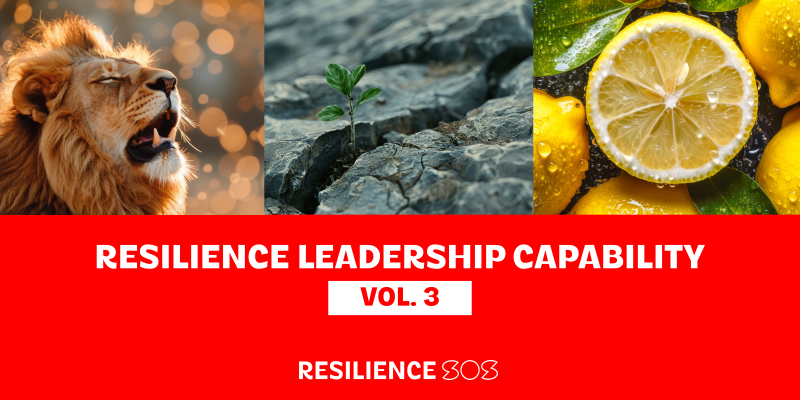
VOL 3: RESILIENCE AND THE MODERN LEADER
Why Great Leadership Isn’t Just Empathetic, It’s Prepared
I. A NEW KIND OF STRONG
In Volume 2 of this series, we explored professional scepticism and the role healthy doubt plays in strengthening leadership judgement.
In this next part, we look at how modern leadership approaches can support resilience when they are applied not just as values, but as capabilities.
Over the last two decades, the leadership landscape has changed.
We’ve moved, rightfully, away from the myth of the all-knowing, unflappable leader who commands from a distance. Today’s leadership playbook is more emotionally intelligent, more participatory, and more human.
We ask leaders to be transparent.
Empathetic.
Vulnerable.
Servant-minded.
System-aware.
And in all of that, we’ve made progress.
But here’s the question:
Are we helping leaders become more resilient or just more likeable?
The risk is that we overcorrect. That we build leaders who are deeply connected to their people, but under-practised at navigating risk, pressure, or sustained uncertainty. We need a model of leadership that’s not just relational but resilient.
II. RESILIENCE DOESN’T CONTRADICT MODERN LEADERSHIP. IT COMPLETES IT.
Let’s take a look at four widely respected leadership models.
Each one holds powerful principles and each one, when integrated intentionally, can fuel the habits of a truly resilient leader.
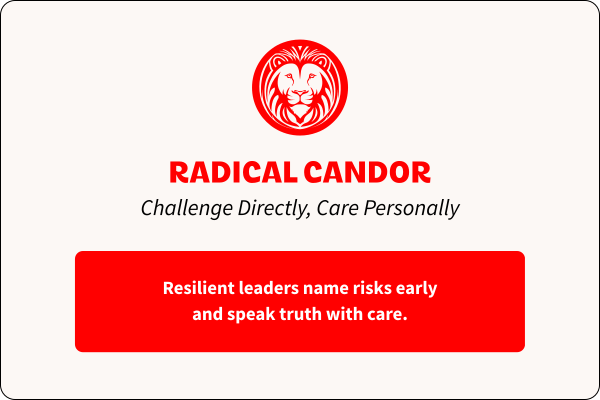
RADICAL CANDOR: Challenge Directly, Care Personally
Radical Candor encourages leaders to give honest feedback with care; to speak truths that help people grow. In a resilience context, this principle is vital.
Resilient leaders name risk early. They don’t soften it.
They build trust not by avoiding discomfort, but by pairing truth with psychological safety.
In practice:
“That process is vulnerable. I know it’s hard to hear but we need to talk about it.”
“We missed something important last time. And we need to learn from it together.”
This mirrors the Lion in the ResilienceSOS Mindset Pillars.
Truth-telling is an act of leadership, and of care.
GROWTH MINDSET: We’re All Still Learning
Carol Dweck’s concept of growth mindset is now a cornerstone of modern leadership.
But in resilience work, it takes on an urgent edge.

This is the essence of the Leaf, in the ResilienceSOS language:
Spotting small signals and treating them as opportunities to grow.
In practice:
“We’re not here to punish the mistake, we’re here to learn from it.”
“Let’s treat this as a rehearsal for something bigger down the line.”
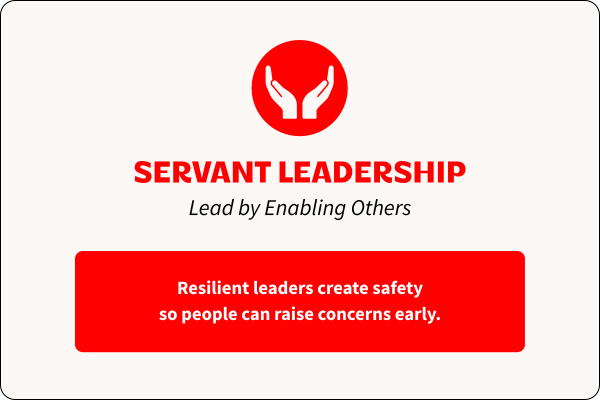
SERVANT LEADERSHIP: Lead by Enabling Others
Popularised by Robert Greenleaf and reframed by modern thinkers like Simon Sinek and Brené Brown, servant leadership is about prioritising the growth, wellbeing and success of the team.
In resilient organisations, servant leaders:
Empower frontline teams to speak up when things feel off
Invest in readiness not just responsiveness
Remove fear from conversations about risk
It’s easy to say, “I’m here to serve.” It’s harder to say, “If something went wrong, would my team feel safe telling me?”
In practice:
“What am I doing that’s making it easier, or harder, for people to raise concerns?”
“How can I protect this team before they’re under pressure?”
SYSTEMS THINKING: See the Whole, Not Just the Part
Resilient leaders don’t just optimise their department, they understand interdependence. They ask:
If we make this decision, where else does the tension show up?
What does this solve now, and what might it compromise later?
What slow burn are we ignoring because it’s not loud yet?
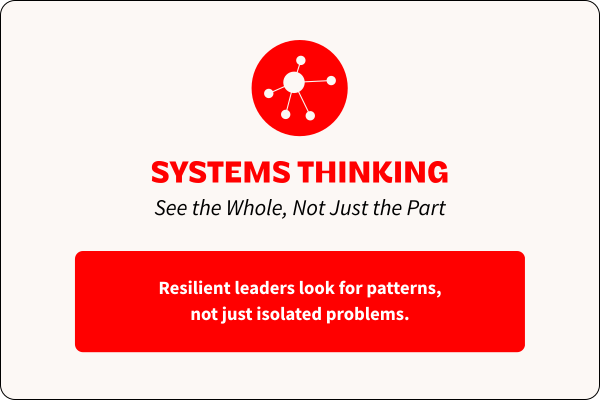
Systems thinkers are pattern spotters. They’re curious about consequences. They know that resilience is fragile when it lives in silos.
In practice:
“What’s the second-order impact of this choice?”
“What happens if this breaks on a public holiday or when no one’s around to fix it?”
III. WHEN THESE TRAITS COMBINE, YOU GET LEADERS WHO ARE READY
Here’s what it looks like when the dots connect:
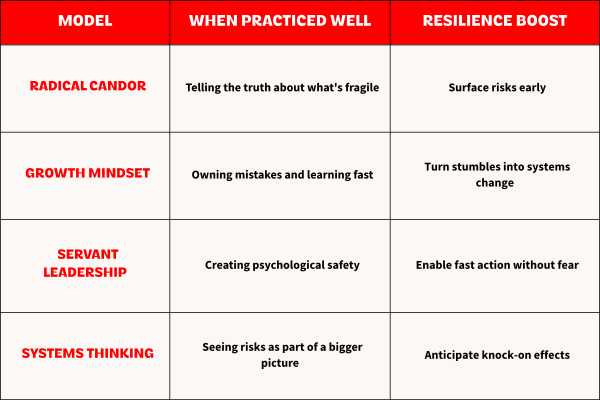
Put together, these leaders are:
Less rattled by uncertainty
More confident inviting challenge
Faster at connecting patterns
And better at holding ambiguity without stalling
They don’t just survive disruption.
They grow through it and help others do the same.
IV. FINAL WORD: RESILIENCE IS A LEADERSHIP COMPETENCY
Too often, resilience is still treated as a character trait. Something innate. Gritty. Heroic.
But resilience is not a personality. It’s a capability, one that can be strengthened, shared, and practised. And the modern leadership models we already admire, when integrated intentionally, can accelerate that development.
It’s not enough to care. We need to be clear.
It’s not enough to be connected. We need to be prepared.
And it’s not enough to survive. We need to learn, adapt, and lead, together.
🔁 NEXT IN SERIES: The Case for Adaptive Intelligence—Building Leaders Who Learn While Leading
Ready to put this into practice?
Start a conversation that builds resilience,
one scenario at a time.
Join the movement.
Follow ResilienceSOS® on LinkedIn for tools, insights, pathways and stories that help leaders lead through uncertainty.
© HumAIn Risk Pty Ltd, trading as ResilienceSOS®. All rights reserved. Please respect our intellectual property rights. This article and its contents are the intellectual property of ResilienceSOS®. You are welcome to use the insights and guidance contained in this article within your own organisation. However, unauthorised reproduction, distribution, or sharing of this article, in whole or in part, outside your organisation or for commercial resale is prohibited without our express permission.

