VOL 4: THE SCIENCE OF SCENARIO THINKING
I. THE LEAD-IN: PREPARATION BEATS PERFECTION
In Volume 3, we explored the human engine of resilience - the intersections between individuals, teams and leaders where real capability lives or leaks.
Volume 4 picks up that thread with a simple truth:
Resilience isn't built by knowing what to do.
It's built by practising how you'll do it - before the pressure hits.
This isn't a slogan - it’s a truth backed by behavioural science, high-performing industries and every team that’s ever been tested under pressure.
Most organisations still treat scenario thinking as a box-ticking exercise—a one-off workshop, a simulation once a year.
But the most resilient organisations?
They rehearse the bad days. Often. Together. Before it’s urgent.
Captain Richard de Crespigny (author of FLY and pilot of QF32) calls this deliberate practice - the disciplined repetition of realistic scenarios until your responses become both calm and capable. High performing industries use this constantly - rehearse, refine, review. Not to predict the unexpected, but to prepare the system for whatever form the unexpected takes.
This volume of More Than a Conversation explores why you should too—and how to do it without turning it into a theatre production.
II. WHY SCENARIO THINKING WORKS (AND WHERE MOST GET IT WRONG)
Let’s start by clearing up a few myths.
Scenario thinking isn’t about paranoia.
It’s about pattern recognition. Mental simulation. Human rehearsal.
It prepares you to:
Notice weak signals early
Navigate surprises calmly
Coordinate with clarity
Learn before failure, not after
THE SCIENCE THAT BACK THIS UP:
Cognitive Psychology: Scenario thinking builds mental rehearsal loops. You can’t predict the future, but you can train your brain to stay calm inside it.
Behavioural Science: Practising difficult moments lowers emotional reactivity. It helps shift teams from panic to pattern response.
Systems Thinking: Scenarios uncover interdependencies—not just what might go wrong, but how risk ripples through teams, processes, and partnerships.
“Rehearsing risk doesn’t make you pessimistic. It makes you prepared.”
III. THE COMMON TRAPS
Even well-intentioned teams fall into predictable traps when running scenario conversations. Here are the ones we see most often - and how to avoid them:

IV. ENTER THE SCENARIO CONVERSATION CARDS
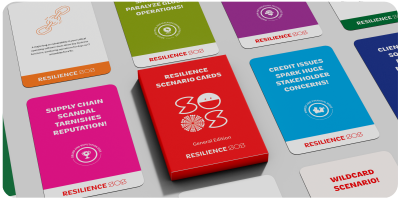
The ResilienceSOS® Scenario Cards were designed to shift scenario thinking from a once-a-year exercise into a regular resilience habit.

Each card is built to:
Trigger four broad questions using the ResilienceSOS® Action Equation:
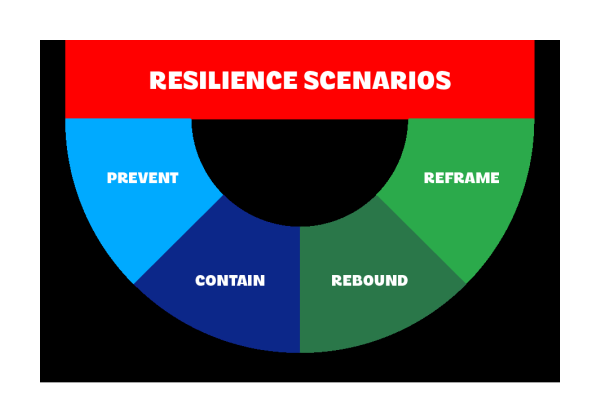
What could we do to Prevent this?
If it happened tomorrow, how would we Contain it?
How would we Rebound from it?
Could we Reframe it into something useful or valuable?
Offer a severe but plausible “What if?” grounded in business reality
End with a mini call to action—something you can tweak, test, or trial straight away

These cards create space for:
Open, blame-free conversations
Fast learning from low-cost failure
Stronger links between individuals, teams, and leaders
They’re not about catastrophising.
They’re about practising how you want to show up when it counts most.
V. HOW TO RUN A SCENARIO CONVERSATION THAT STICKS
You don’t need a war room. You need a whiteboard, 30 minutes, and the courage to test your assumptions.
Here’s the flow:
1. START WITH OBJECTIVE
What are you trying to protect, deliver, or uphold?
Examples:
“Keep customer support running during disruption.”
“Maintain trust with stakeholders during a change.”
“Deliver our service on time despite complexity.”
2. INTRODUCE THE SCENARIO
What’s a pressing “What if?” that could threaten that objective?
Pick one from a Scenario Card or create your own.
Examples:
“What if our supplier fails mid-project?”
“What if we lose access to key data for 48 hours?”
“What if a key staff member is unexpectedly unavailable?"
3. WORK THROUGH THE ACTION EQUATION
Together, ask:
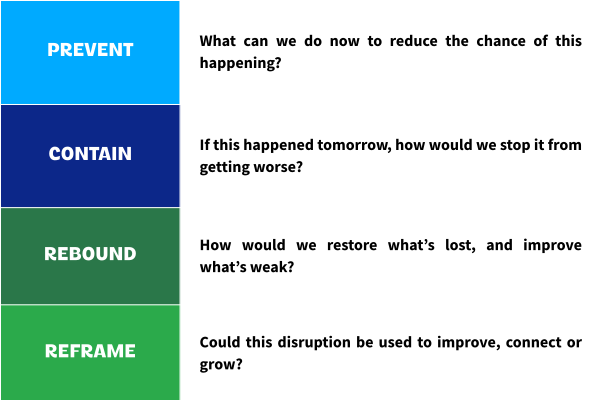
Don’t aim for perfection—aim for honest reflection and shared understanding.
4. END WITH ONE ACTION COMMITMENT
What’s one thing you’ll do differently now?
Maybe it’s reviewing a dependency. Updating a contact list. Checking your assumptions. Booking a follow-up chat.
The key is momentum, not magnitude.
VI. WHY THIS IS A GAMECHANGER
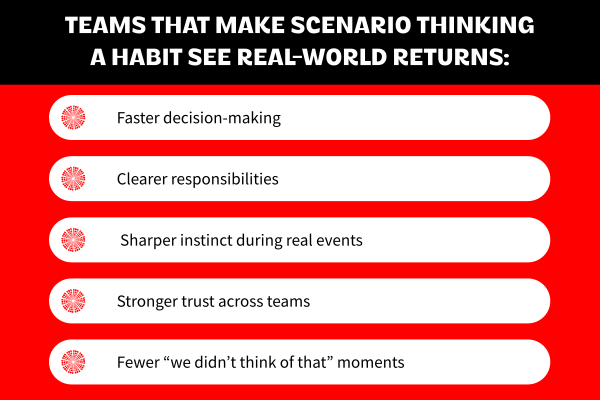
And perhaps most importantly:
They feel confident, not complacent.
VII. FINAL WORD: THIS ISN’T ABOUT PREDICTION. IT’S ABOUT PREPARATION.
You can’t predict the future.
You can prepare for its shape.
Scenario thinking doesn’t guarantee you’ll avoid disruption.
But it guarantees you’ll be faster, clearer, and more human in how you respond.One card.
One conversation.
One shift at a time.
Coming in Volume 5: The Language of Lions, Leaves and Lemons — How the Manifesto Shapes Culture in Moments That Matter.
Ready to put this into practice?
Start a conversation that builds resilience,
one scenario at a time.
Join the movement.
Follow ResilienceSOS® on LinkedIn for tools, insights, pathways and stories that help leaders lead through uncertainty.
© HumAIn Risk Pty Ltd, trading as ResilienceSOS®. All rights reserved. Please respect our intellectual property rights. This article and its contents are the intellectual property of ResilienceSOS®. You are welcome to use the insights and guidance contained in this article within your own organisation. However, unauthorised reproduction, distribution, or sharing of this article, in whole or in part, outside your organisation or for commercial resale is prohibited without our express permission.

