VOL 4: THE CASE FOR ADAPTIVE INTELLIGENCE
Building Leaders Who Learn While Leading
I. WHEN EXPERIENCE ISN’T ENOUGH
In Volume 3 of this series, we explored how modern leadership approaches—from Radical Candor to Systems Thinking—can strengthen resilience when applied intentionally.
This next part turns to the capability that allows leaders to navigate complexity as it unfolds.
Adaptive intelligence.
We often say leadership is tested in a crisis.
But it’s not really the crisis that’s the test, it’s the adaptation that follows.
The world has become too fast, too ambiguous, and too interconnected for experience alone to anchor good leadership. What worked last time might make things worse next time. And yet, many leadership models still reward decisiveness over discernment, answers over enquiry, and speed over sense-making.
What’s needed now is a new kind of capability: adaptive intelligence.
This isn’t about knowing more. It’s about learning faster.
It’s not about having the plan. It’s about seeing the pattern.
And it’s not about controlling the chaos but evolving within it.
II. DEFINING ADAPTIVE INTELLIGENCE (AQ)
You’ve likely heard of IQ (intellectual intelligence) and EQ (emotional intelligence). AQ—adaptive intelligence is the third horizon.
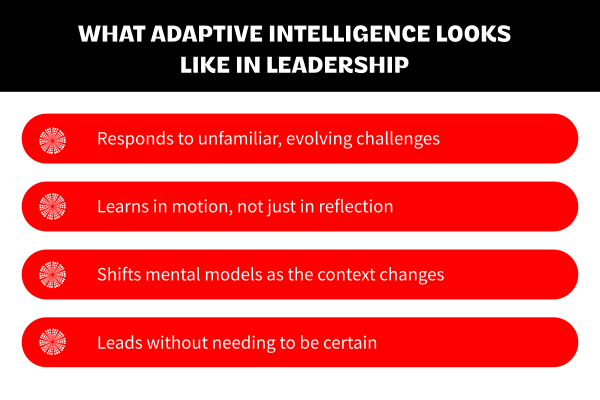
AQ is not a fixed trait. It’s a learnable skillset built on curiosity, flexibility, pattern recognition, and the ability to metabolise change.
In resilience terms, AQ is what stops a disruption from becoming a derailment.
III. WHERE ADAPTIVE INTELLIGENCE SHOWS UP
High-AQ leaders don’t just react to change, they work with it.
They’re calm without being passive. Curious without being aimless. Action-oriented without being reckless.
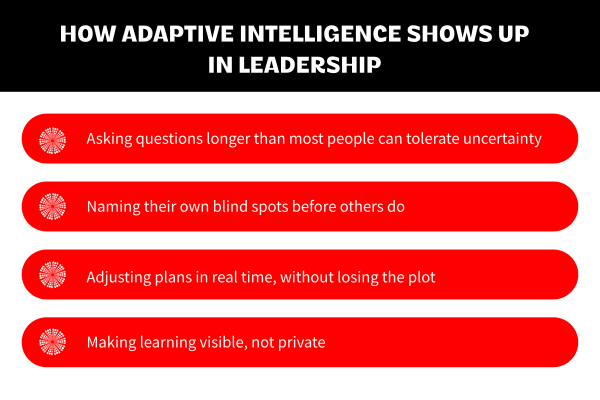
This is the leader who says,
“I was wrong about that and here’s what I’ve seen since then.”
“Let’s evolve our approach based on the signals we’re getting, not the plan we wrote six months ago.”
They don’t wait for perfect clarity. They build just enough clarity to move forward, together.
IV. WHY AQ IS ESSENTIAL FOR RESILIENCE
Resilience isn’t about holding your ground.
It’s about shifting your ground with purpose.
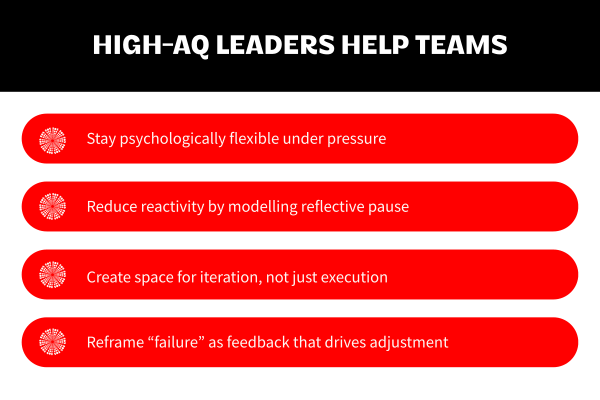
They hold space for not knowing and lead anyway.
This builds organisational confidence. Not just because someone has the answer, but because someone is willing to explore the unknown in good faith, with structure and trust.
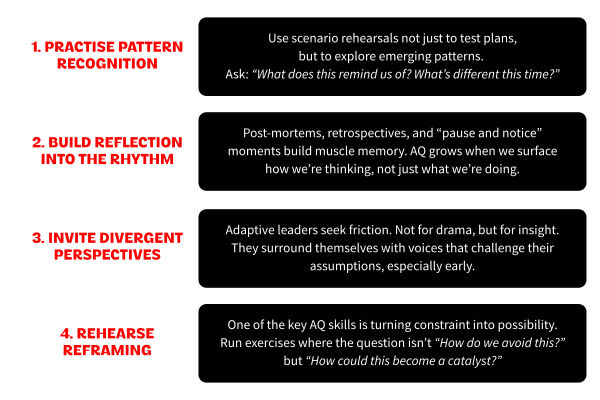
V. CULTIVATING ADAPTIVE INTELLIGENCE
If AQ isn’t fixed, how do we grow it?
VI. WHAT STOPS AQ FROM TAKING HOLD
Ironically, the biggest threat to adaptive intelligence is leadership success, i.e. when people feel they’ve already arrived. The more senior the leader, the harder it can be to stay open, curious, and flexible. Add pressure, and certainty starts to feel like the only safe response.
But the truth is: no one knows what’s coming next.
The best leaders don’t pretend to. They practise noticing earlier, adjusting faster, and learning publicly.
VII. FINAL WORD: LEARNING WHILE LEADING
We’re past the point where leadership is about knowing.
We’re now in the era where leadership is about learning, and bringing others along as you do.
Adaptive intelligence is not a soft skill.
It’s the skill that turns ambiguity into action, and setbacks into strategy.
It’s how resilience gets lived in the moment, under pressure, with others.
Train it. Trust it. Use it.
🔁 NEXT IN SERIES: AI in the C-Suite—What Changes When the Thinking Isn’t All Human?
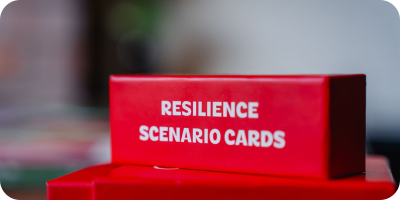
Ready to put this into practice?
Start a conversation that builds resilience,
one scenario at a time.
Join the movement.
Follow ResilienceSOS® on LinkedIn for tools, insights, pathways and stories that help leaders lead through uncertainty.
© HumAIn Risk Pty Ltd, trading as ResilienceSOS®. All rights reserved. Please respect our intellectual property rights. This article and its contents are the intellectual property of ResilienceSOS®. You are welcome to use the insights and guidance contained in this article within your own organisation. However, unauthorised reproduction, distribution, or sharing of this article, in whole or in part, outside your organisation or for commercial resale is prohibited without our express permission.

