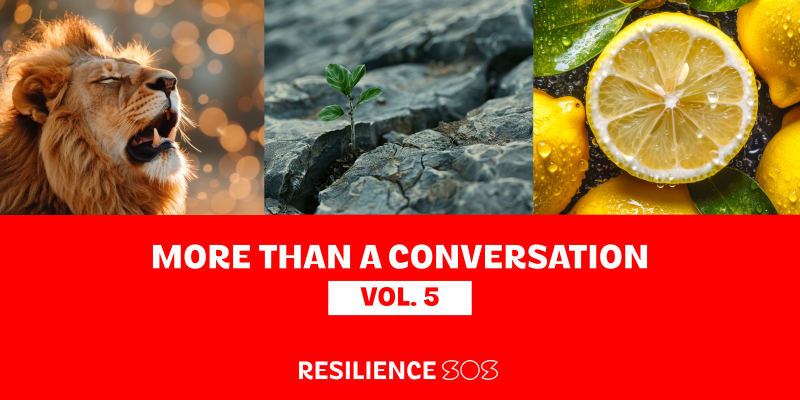
VOL 5: THE LANGUAGE OF LIONS, LEAVES AND LEMONS
I. WHY LANGUAGE IS A LEVER FOR RESILIENCE
In Volume 4, we explored how deliberate practice strengthens resilience long before pressure hits.
But practice alone isn't what people reach for in the heat of the moment - they reach for language. The phrases that cut through noise. The words that steady thinking. And the shared vocabulary that helps teams act with clarity when stakes rise.
Volume 5 explores why that language matters - and how the Manifesto puts that language to work.
When something goes wrong, people reach for the simplest words available - and often, the shortest phrase in the room wins.
If your people don’t have simple, powerful language for risk and resilience, they default to silence, blame, or chaos.
That’s where the ResilienceSOS® Manifesto steps in. It turns strategy into story. Values into verbs. Pressure into permission to act.
The symbols — the Lion, the Leaf, and the Lemon — are more than metaphors. They’re behavioural triggers, rooted in science and designed for real-time use.
II. THE SCIENCE BEHIND THE SYMBOLS
THE LION

Theme: Speak up. Name risks. Lead with clarity.
The Lion is about more than honesty — it’s accountability in motion.
It gives teams permission to say what’s hard without fear of being punished for it. But it also demands follow-through.
Because naming the risk isn’t enough.
Resilience happens when it’s tamed, not just mentioned.
I’ll never forget a post-incident review after a major cyber crisis.
The breach itself wasn’t the true failure. The real issue was a chain of overlooked risks:
Technology defects repeatedly de-prioritised
Go-live checklists where risks were “noted but accepted”
Compliance requirements quietly marked “low priority”
Each felt manageable on its own. But together?
1 + 1 + 1 = Organisational vulnerability.
The review didn’t expose bad people — it revealed a cultural blind spot:
“We’re good people, so that kind of thing doesn’t happen to us.”
Good intent doesn’t protect you.
But good systems — and courageous action — can.
Why it matters
Psychological safety enables people to surface the risk.
A follow-through culture ensures it’s acted upon.
Language in action
“This feels like a Lion — let’s say what we’re seeing.”
“We’re not here to blame. We’re here to tame.”
“What have we named lately that we’ve failed to follow through on?”
THE LEAF
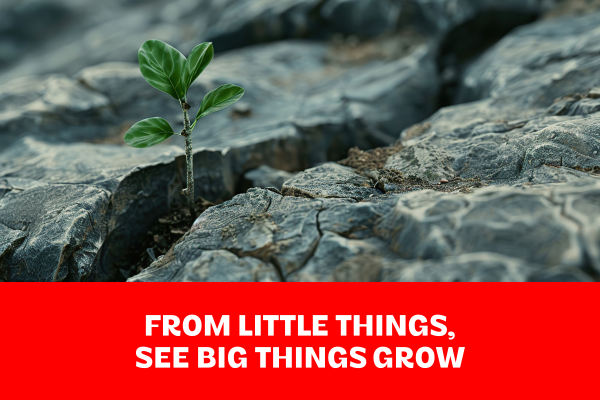
Theme: Start small. Stay curious. Don’t ignore the near-miss.
The Leaf is a call to track micro-signals and honour small actions.
Why it matters
Near misses are goldmines for learning — if they’re surfaced and shared.
Vigilance is a trait of adaptive organisations; they don’t wait for failure to learn.
Continuous improvement starts with daily observations, not big initiatives.
Rationale: Small problems are tomorrow’s crises in disguise.
Language in action
“That’s a Leaf — we almost missed it.”
“Add it to our Leaf log. We’ll look for patterns later.”
“It’s small now, but let’s not assume it stays that way.”
THE LEMON

Theme: Reframe the challenge. Find the upside. Use disruption for good.
The Lemon gives teams permission to find opportunity inside adversity.
Why it matters
Cognitive flexibility enables faster recovery and innovation after shock.
Teams who reframe stress as growth potential build stronger cohesion and creativity.
Reframing shifts the question from “Why us?” to “What now?”
Rationale: Not all risk can be prevented, but every challenge can be mined for meaning.
Language in action
“Yep, it’s a Lemon. But is there something we could redesign here?”
“We didn’t expect this, but now that it’s here, how can we use it?”
“If this is the squeeze — what’s the juice?”
III. SYMBOLS THAT STICK (WHEN SLIDES DON’T)
Why do these three resonate?
Because they’re:
Visual — you can see them and point to them.
Memorable — they cut through complexity.
Usable — they give you language for tough moments, not just slogans for the wall.
In a status meeting, someone says:
“We’ve got a Leaf we’ve been ignoring.”
In a post-mortem, a leader reflects:
“That was a Lemon we didn’t squeeze hard enough.”
In a team chat, someone types:
“Feels like a Lion — are we naming this or avoiding it?”
That’s what cultural maturity sounds like.
IV. HOW TO USE THE LANGUAGE — NOT JUST LOVE THE SYMBOLS
To embed the Manifesto, you don’t need a campaign. You need consistency, curiosity, and a little courage.
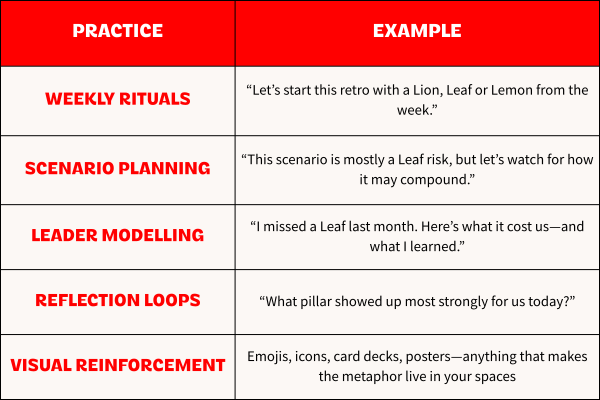
Over time, these words become more than signals. They become standards.
V. WHAT THIS LANGUAGE UNLOCKS

A Lion helps you face what’s hard.
A Leaf helps you notice what’s small.
A Lemon helps you use what’s unexpected.
That’s not just clever. It’s culture.
VI. FINAL WORD: SAY IT UNTIL IT STICKS
Culture isn’t built in the crisis.
It’s revealed in it.
The work now is to practise the language of resilience when the stakes are low — so it’s there when the heat is on.
Because the words you use under pressure become your culture.
"Let them be courageous."
"Let them be clear."
"Let them be human."
Coming in Volume 6: Resilience as a Shared Habit — What Happens When Everyone Feels It’s Their Job
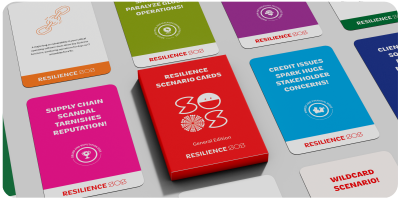
Ready to put this into practice?
Start a conversation that builds resilience,
one scenario at a time.
Join the movement.
Follow ResilienceSOS® on LinkedIn for tools, insights, pathways and stories that help leaders lead through uncertainty.
© HumAIn Risk Pty Ltd, trading as ResilienceSOS®. All rights reserved. Please respect our intellectual property rights. This article and its contents are the intellectual property of ResilienceSOS®. You are welcome to use the insights and guidance contained in this article within your own organisation. However, unauthorised reproduction, distribution, or sharing of this article, in whole or in part, outside your organisation or for commercial resale is prohibited without our express permission.

