VOL 6: RESILIENCE AS A SHARED HABIT
I. WHY THIS MATTERS
Volume 5 showed how language gives teams a way to name risks, notice signals and reframe challenges.
Volume 6 explores what happens next - turning that language into habit. Resilience doesn't shift culture until it shifts behaviour - and behaviour only sticks when everyone sees it as their job.
Organisational resilience is often misunderstood as a function, a framework, or a fallback plan.
But resilience isn’t built in boardrooms or binders.
It’s built in hallway conversations, in everyday decisions, and in the small, unglamorous moments when someone spots a risk, shares a concern, or chooses to ask a better question.
Resilience doesn’t live in a department.
It lives in the day-to-day.
This volume of More Than a Conversation shows how that daily, distributed work becomes a shared habit —
the moment resilience stops belonging to a department and starts belonging to everyone.
Because when everyone feels it’s their job, that’s when resilience becomes real.
II. THE DIFFERENCE BETWEEN BEING “GOOD IN A CRISIS” AND BEING TRULY RESILIENT
“We’re good in a crisis.”
I used to hear that all the time. And for a while, it felt true.
We were small enough to know each other’s strengths. When pressure hit, people stepped up, cared deeply, and worked tirelessly to get things back on track.
It was human, capable, committed resilience in action.
But once the crisis passed, something happened.
The muscle memory vanished.
“That’s not part of my role.”
“This isn’t a priority right now.”
“We’ll circle back later.”
The decision-making that had been fluid under pressure began to stall. Risk conversations dried up. Progress slowed.
And we lost the very capability that had carried us through.
It taught me something powerful:
Crisis resilience is not the same as cultural resilience.
Cultural resilience is what shows up when there’s no siren. No deadline. No adrenaline.
Just your normal day.
That’s the goal — to build resilience that isn’t conditional on chaos.
III. THE BUILDING BLOCKS OF SHARED RESILIENCE
From our fieldwork and behavioural research, shared resilience rests on three essentials:

IV. FROM MOMENT TO MOVEMENT: BUILDING THE FLYWHEEL
Once those habits start, momentum follows.
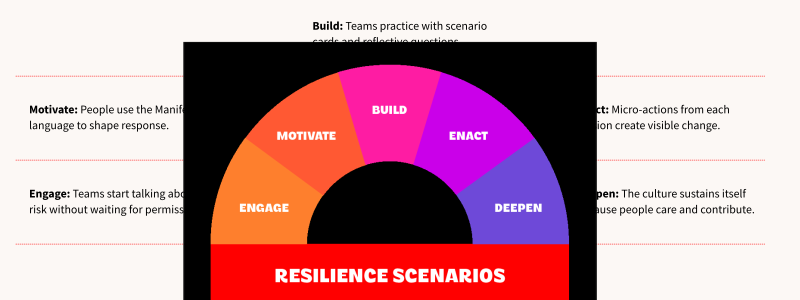
Each turn builds the next.
And the more turns you make, the lighter the lift.
V. WHAT SHARED RESILIENCE LOOKS LIKE IN THE WILD

The result?
Everyone acts.
No one burns out.
And the organisation learns faster than the environment changes.
VI. HOW TO MAKE IT A HABIT — WITHOUT A PROGRAM
Start small. Repeat. Make it visible.
That’s the playbook.

The key is rhythm, not rocket science.
VII. THE PAYOFF: WHEN EVERYONE FEELS IT’S THEIR JOB

And most importantly —
Resilience becomes something we do, not something we delegate.
FINAL WORD: WHEN THE LIFT IS SHARED, IT FEELS LIGHTER
Resilience shouldn’t rely on adrenaline.
It should rely on each other.
When everyone contributes — when risk is named, responsibility is shared, and learning is continuous — the system strengthens with every turn.
A resilient organisation isn’t defined by how it bounces back.
It’s defined by how it shows up every day.
Together.
Coming in Volume 7: Leadership in the Grey Zone How Great — Leaders Show Up When the Path Isn’t Clear
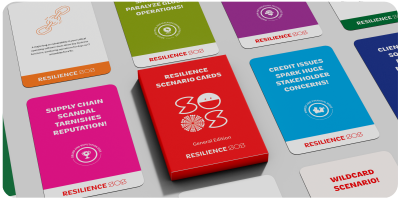
Ready to put this into practice?
Start a conversation that builds resilience,
one scenario at a time.
Join the movement.
Follow ResilienceSOS® on LinkedIn for tools, insights, pathways and stories that help leaders lead through uncertainty.
© HumAIn Risk Pty Ltd, trading as ResilienceSOS®. All rights reserved. Please respect our intellectual property rights. This article and its contents are the intellectual property of ResilienceSOS®. You are welcome to use the insights and guidance contained in this article within your own organisation. However, unauthorised reproduction, distribution, or sharing of this article, in whole or in part, outside your organisation or for commercial resale is prohibited without our express permission.

