VOL 7: LEADERSHIP IN THE GREY ZONE
I. WHY THIS MATTERS
In Volume 6, we looked at resilience as something lived - a daily practice shared across teams.
This final volume in the series steps into the place where practice matters most: the grey zone. The moments where uncertainty is unavoidable, guidance is thin, and leadership becomes an act of judgement, not a search for certainty.
Across the series, we’ve written about frameworks, metaphors, habits, and shared language - the building blocks of resilient practice. The grey zone is where all of that is stress-tested and where many of the most consequential leadership moments live.
This is the place where:
Policy runs out
The rulebook is silent
Data is thin, contradictory, or emotionally charged
Consequences are unclear
Pressure is high but the path is not
It’s the space between “wait for more” and “move now.”
And it’s here that resilient leadership is most visible — and most valuable.
II. GREY ZONE MOMENTS AREN’T RARE — THEY’RE REALITY
You might assume more data eliminates grey. It doesn’t. Models and reports may look crisp — but they rest on assumptions, judgements and interpretation. The value of a model is not only its number, but the explanation that makes the number useful.
When I worked with actuaries, the most important artifact wasn’t the output — it was the documentation of assumptions:
Here’s what we chose. Here’s why. Here’s what that means.
I carried that approach into regulatory and operational leadership: show your working, invite scrutiny, improve the result.
Good grey-zone leadership isn’t pretending certainty. It’s saying, “Here’s how I’m thinking about this — tell me what I’m missing.”
III. WHY THE GREY ZONE IS SO HARD (AND SO DANGEROUS)
The grey zone is both cognitively and culturally uncomfortable:
The brain craves certainty — ambiguity causes stress and slows decisions.
Organisations often punish visible mistakes, so people default to inaction, reactive choices, or safe deferral.
Grey-zone leadership is quiet work: slow to reward, easy to get wrong, and hard to measure.
Ignoring the grey doesn’t make it disappear. It makes you blind to it.
IV. HOW GREAT LEADERS NAVIGATE GREY

This reflects adaptive leadership: technical solutions won’t fix adaptive problems. You need interpretation, values and sense-making.
Language you can use right now:
“Here’s how I’m thinking about this — tell me what I’m missing.”
“This is a grey zone. Based on our values, here’s where I’d lean.”
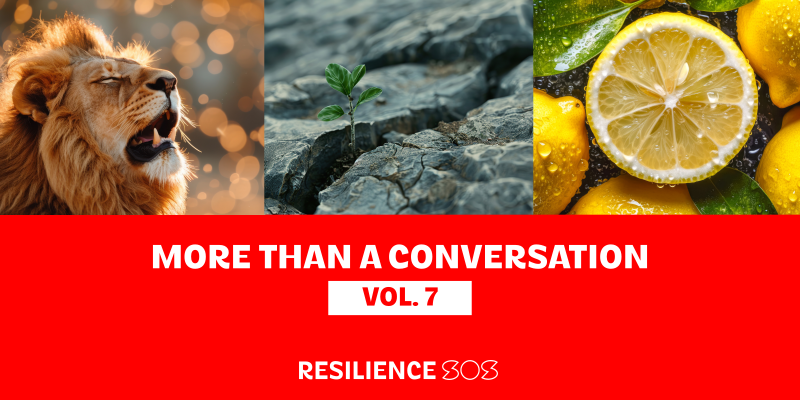
“Let’s use Lion / Leaf / Lemon — which lens fits this challenge?”
V. TOOLS FOR LEADING IN GREY
Simple, repeatable tools help leaders act with clarity:
Show Your Working
Explain assumptions, logic, and what evidence would change your mind.
Use the Action Equation
Apply Prevent / Contain / Rebound / Reframe not only for crises but for ambiguity
Lean on the Manifesto

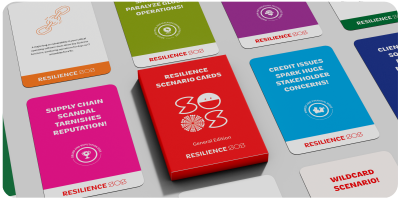
Practice Grey-Zone Scenarios
Run cases with no single right answer; focus on process over perfect outputs.
VI. THE COST OF SILENCE — THE POWER OF TRANSPARENCY
When leaders don’t name the grey:
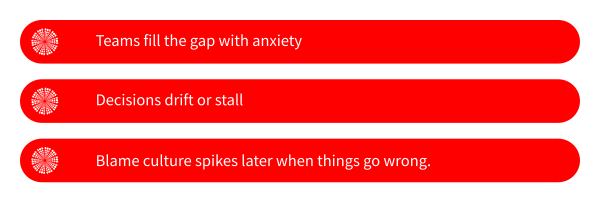
When leaders hold ambiguity and still move forward:

Transparency is not a weakness — it’s the mechanism that converts uncertainty into collective judgement.
VII. PRACTICAL PROMPTS FOR THE NEXT GREY MOMENT
Use these prompts in meetings, briefings or notes to make grey-zone thinking visible:
“Here are the assumptions underlying this view. Which do you disagree with?”
“If we had to decide with 48 hours of data, what would we do first?”
“Which of our values should guide this trade-off?”
“What evidence would make us pivot in the next week?”
Small prompts produce clearer reasoning and faster, safer action.
FINAL WORD: HOLD THE SPACE, LIGHT THE WAY
Leadership in the grey zone is not about being right. It’s about being real, reflective, and responsive. Show your thinking. Say what you see. Make it safe to speak.
When the map is missing, the clearest compass is transparency. That’s how leaders turn ambiguity into better decisions — and how organisations grow the judgement they’ll need for whatever comes next.
This volume closes the first More Than a Conversation series — seven volumes on what it really takes for resilience to live and breathe inside modern organisations. From mindset and metaphor, to human connection, deliberate practice, shared habits and leadership in uncertainty, each volume traced a different thread of what makes people and systems stronger.
And while this volume ends the series, it doesn’t end the work. Future editions will continue the conversation — deepening the practice, expanding the tools, and shining a light on the moments that matter most when the world moves faster than certainty.
Ready to put this into practice?
Start a conversation that builds resilience,
one scenario at a time.
Join the movement.
Follow ResilienceSOS® on LinkedIn for tools, insights, pathways and stories that help leaders lead through uncertainty.
© HumAIn Risk Pty Ltd, trading as ResilienceSOS®. All rights reserved. Please respect our intellectual property rights. This article and its contents are the intellectual property of ResilienceSOS®. You are welcome to use the insights and guidance contained in this article within your own organisation. However, unauthorised reproduction, distribution, or sharing of this article, in whole or in part, outside your organisation or for commercial resale is prohibited without our express permission.

